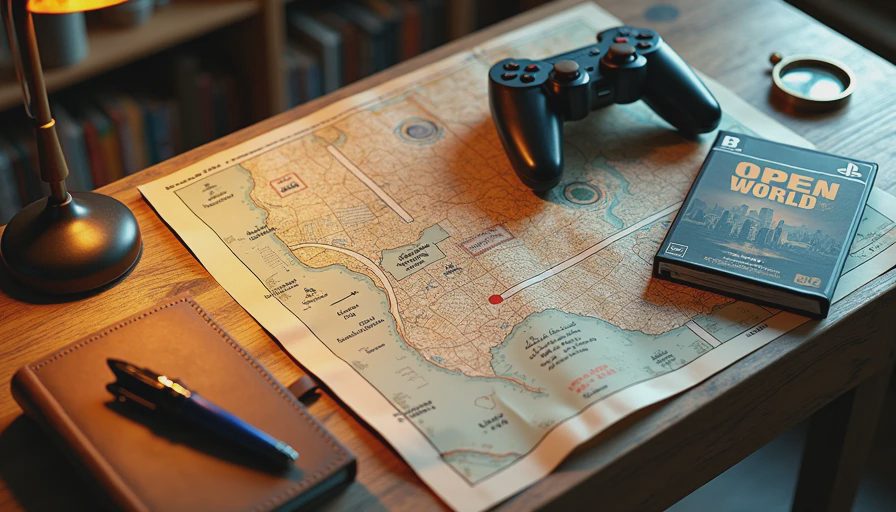
The Map I Remember
I remember the first time I played Grand Theft Auto III.
It was 2001. I was 17. I had just gotten my driver's license. I was obsessed with the idea of freedom—real freedom, the kind that came with a car and a full tank of gas.
Liberty City felt enormous. I'd drive for hours, exploring every corner of the map. The city was dense, detailed, and full of secrets. I thought it was the biggest map I'd ever seen.
It wasn't. Liberty City is about 6 square kilometers. That's about the size of a small neighborhood. It's tiny by modern standards.
But it felt huge.
In 2026, I look at Liberty City and see a small, dense map. I can drive across it in a few minutes. The buildings are simple. The textures are low-res. The world is limited.
And yet, I still think about it. I still remember the feeling of discovery. I still remember getting lost in that city.
Old open-world games weren't really bigger. They just felt different. And sometimes, that difference makes them better.
The Comparison
Modern open-world games are enormous.
Red Dead Redemption 2's map is about 75 square kilometers. The Witcher 3 is about 136 square kilometers. Assassin's Creed Odyssey is over 250 square kilometers.
These maps are huge. They're detailed. They're beautiful. They're filled with content.
And sometimes, they're overwhelming.
I've played modern open-world games where I spent more time traveling than playing. I've played games where the map was so big I never finished exploring. I've played games where the content was so spread out it felt empty.
Modern open-world games are impressive. But they're not always satisfying.
Why Old Games Felt Bigger
Old open-world games felt bigger for a few reasons.
Slower movement. In GTA III, you drove a car. You could only go as fast as the car allowed. In modern games, you can fast travel, fly, or use super-speed. Old games made you experience the space.
Limited fast travel. Fast travel was limited or nonexistent in old games. You had to drive or walk everywhere. This forced you to learn the map and experience the world.
Denser design. Old maps were smaller but denser. Every street had something interesting. Every corner had a secret. The content was packed together.
No hand-holding. Old games didn't have glowing paths, compass markers, or quest logs. You had to explore. You had to remember where things were.
What Was Better
Old open-world games did some things better.
The sense of discovery. You had to find things on your own. There were no map markers telling you where to go. Discovery was earned.
The sense of place. You learned the map. You knew the streets. You knew the shortcuts. The world felt like home.
The density. Every area had something interesting. There was no empty space. You were always engaged.
The challenge. The world was more dangerous. You couldn't fast travel out of danger. You had to survive.
What Was Worse
Old open-world games had their problems too.
The graphics. The visuals are dated. The textures are low-res. The worlds are simple.
The variety. Old games had less variety. Fewer biomes, fewer environments, fewer things to discover.
The content. Old games had less content. Fewer quests, fewer activities, fewer things to do.
The performance. Old games had technical issues. Poor frame rates, long load times, bugs.
The Verdict
So, are old open-world games better than modern ones?
No. But they're different.
Modern open-world games are bigger, more beautiful, and more content-rich. They're objectively better in many ways.
But old open-world games had something modern games lost. They had density. They had discovery. They had a sense of place. They had challenge.
Modern games are impressive. But they're not always satisfying. Sometimes bigger isn't better. Sometimes the smaller, denser world is more engaging.
Important doesn't always mean replayable. But old open-world games have something that modern games sometimes lose—a sense of place.
Still worth loading? Yes—if you appreciate the density and discovery.
No signals yet — transmit the first.